
Would an AI crash actually hit your business?
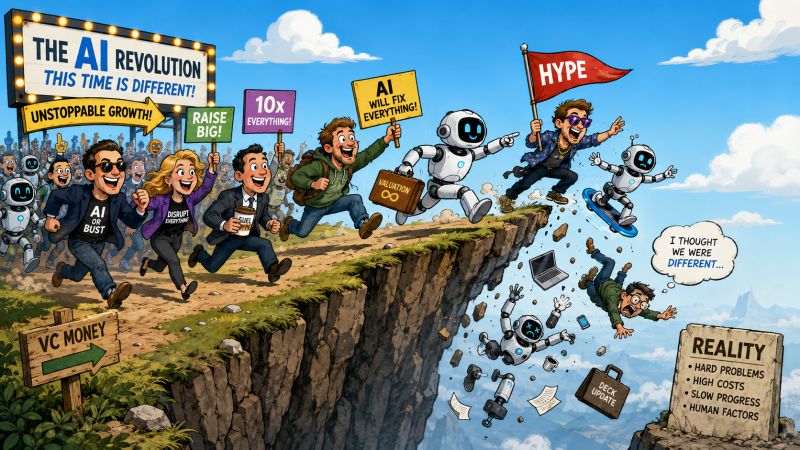
That AI crash many are predicting: should your business care?
Gloaters say we will all be on the beach in a cornucopia of abundance in a few years. Doomers say the whole AI market will have crashed by then. The latter make a better case, but it may not matter for your AI adoption decisions.
Current AI lab and hyperscaler valuations are unsustainable. $20bn in revenue against a trillion-plus in investment is more of a bet than a business model. Add large pinches of geopolitical chaos, energy constraints, and the oldest pattern in tech: the boom-bust cycle. Something will give.
But here is the question I have not seen asked (let alone answered): would an AI crash actually hit your business?
Maybe not, and for three reasons. First, you are their revenue. When consolidation comes, chaotic or not, the survivors need your subscription to justify what remains of their valuations. Second, the services you depend on exist already. A valuation correction does not switch them off, although it may change provider. Third, the technology and infrastructure do not disappear in a crash. Little to worry for an SME with some nice working AI use cases and the option to move to open source models.
So any crash, no matter how photogenic and wrenching, is mostly noise for your planning horizon. Ignore it.
What you should not ignore is pricing risk. The current loss-leader era will end. Token costs already scale non-linearly as you move AI into core processes, making you more vulnerable than you may think. And the absurdly high value these models deliver for the right use cases will eventually be priced accordingly.
Later this week, I'll take an in-depth look at what basic economics has to say about what AI may cost by the end of the decade, and what that means for your business case today.
This piece first appeared on LinkedIn.