
What should my daughter study in the age of AI?
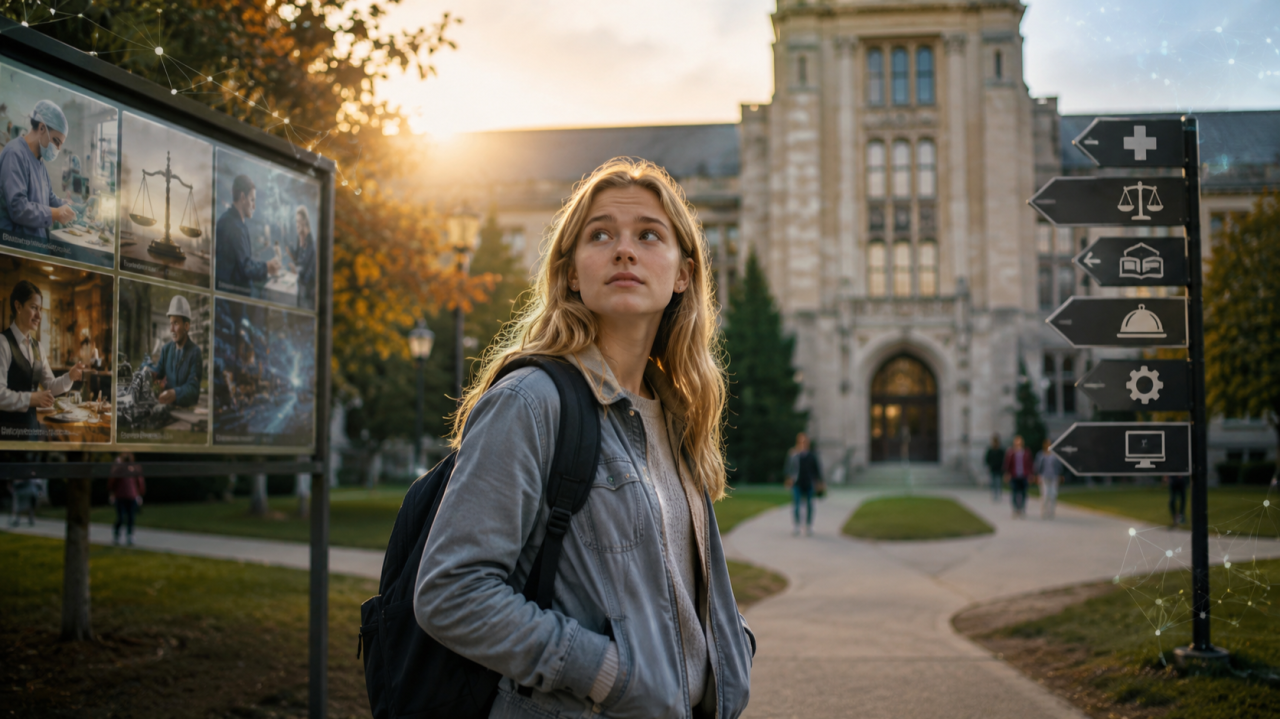
My daughter is choosing a college program in interesting times. I hope she chooses more wisely than I did. Here's how I am trying to help.
When I was 17, I went with economics. Broadly focused, flexible. I thought I was being sensible. Except: I quickly found out that the friends who picked engineering or chemistry had more fun studying. And then ended up at Morgan Stanley and McKinsey all the same. Plus, they could have become engineers or chemists if they had wanted to. I had foreclosed options I didn't even know I was foreclosing. Specialize first, generalize later. Hindsight brings many benefits ;-)
So what should my progeny study in 2027, with AI munching at everything in sight?
The internet is full of lists and advice. Most are contradictory, and the goalposts move monthly. I've spent much time thinking about AI's business and societal consequences. Now, for us, it's a key part of choosing a college program.
AI doesn't just reshuffle which professions will thrive. It changes the optimization function itself.
When I was 17, the question was whether to specialize or generalize. In 2027, I think four other criteria matter more. What human specialty or trait is "unmachineable" and should be aimed for by the young of body (and/or mind)?
- Be interesting. Yes, machines now create art, medicines and math proofs. But watching humans do stuff is more fun, and our societal hierarchy needs oxygen. Ten years from now, the world championships of soccer, chess or seagull imitation will be more popular than ever. Learn to make something, perform something, build something. Become the kind of person other people want in the room, on the stage or at the table.
- Judge well. Machines have no trouble deciding, but deciding well? Judgment requires something at stake. An experienced person with a track record, a network, a physical body, human character and consequences to live with makes fundamentally different decisions from a machine. Seek out challenges and varied projects early. Judgment is just experience, compressed.
- Own things. AI can't. In an economy where machines do work, their returns flow to whoever owns the capital, the machines, the data, the IP. The practical advice is uncomfortable but simple: accumulate assets ASAP. Invest in the AI revolution rather than merely participating in it as a worker. Save up. Aim for a high paying job (within ethical constraints). Returns will be high and with any luck you'll end up closer to the top of the baboon rock.
- Be accountable. You can delegate a task to a machine. But the buck still stops with a human. That person signs off. That person gets sued. That person also gets paid. Choose a path that gets you into that chair. This may overlap with ownership, but plenty of inspectors, regulators and politicians own very little yet hold positions of trust.
So I came up with a modest framework, but now it's over to my daughter. Medicine scores well on all 4 criteria, especially child-facing care. It is accountable, empathic and with growing and elastic (=near unlimited) demand. Social work is underrated: high human interest, high empathy, high accountability, AI-resistant in the ways that count, and the demand curve only goes one way in a turbulent world. Teaching belongs on the list too. So does hospitality and hotel management, growth markets if ever there were any.
The common thread is not prestige. It is human trust, responsibility, context and presence.
Coding and consulting? Iffy for a starter. The role is changing in ways that favor experience and broad skills; people like us (sorry) can leverage AI to do alone what took a whole team in the past. These once secure career choices now look questionable, and unemployment is opening up visibly.
Any teenager could do worse than avoiding the no-go college programs, attending a reputable institution and then systematically building skills, networks, capital and reputation. The school itself still matters. Your friends will become your network and teach you more of relevance than any lecture ever can. Just as before, but more.
Whether I've just written the career advice equivalent of my own economics degree remains to be seen. Ask me again in twenty years. By then my daughter, and fate, will have decided whether she is a speech therapist, cruise director or European champion in seagull imitation.
This piece first appeared on LinkedIn.